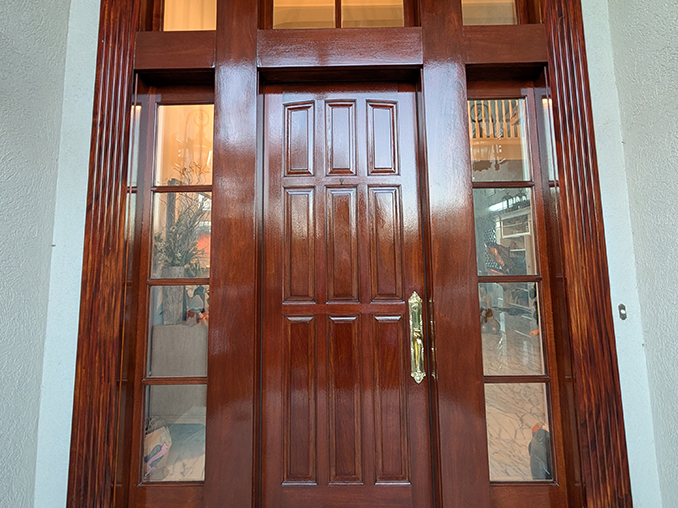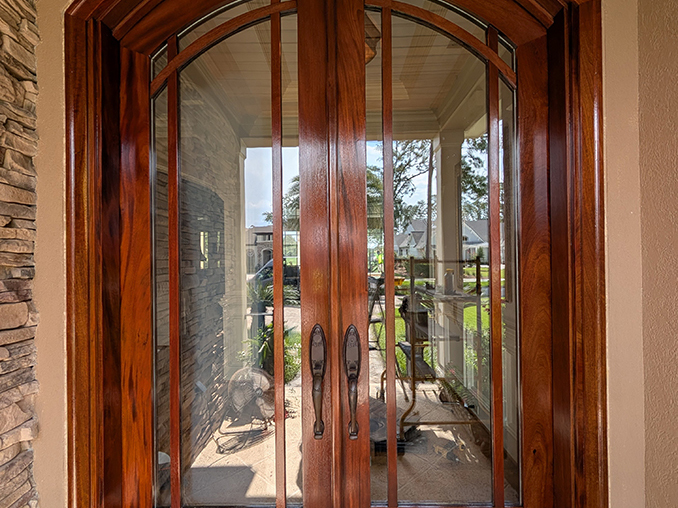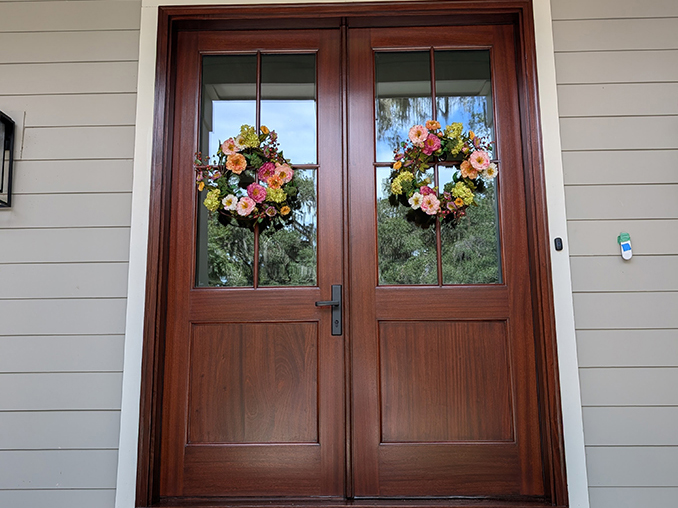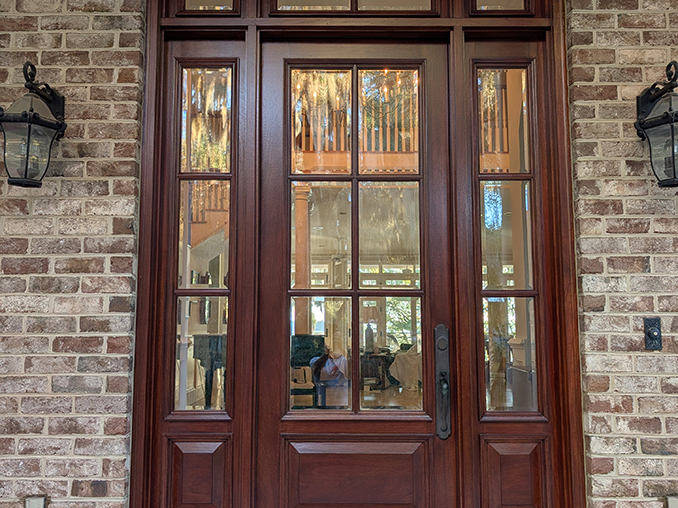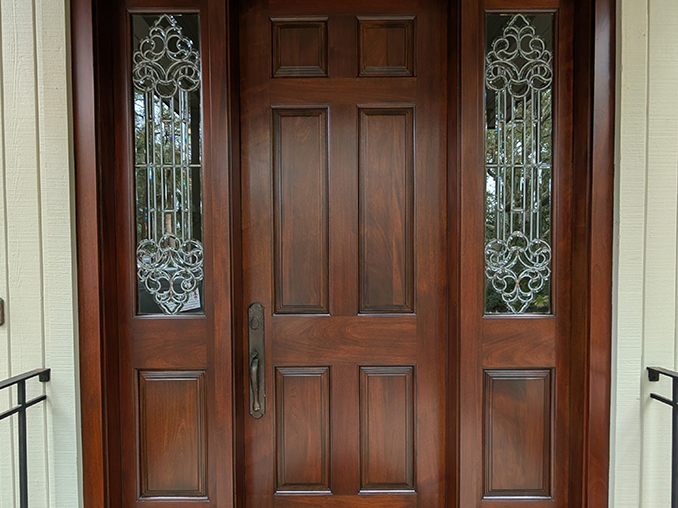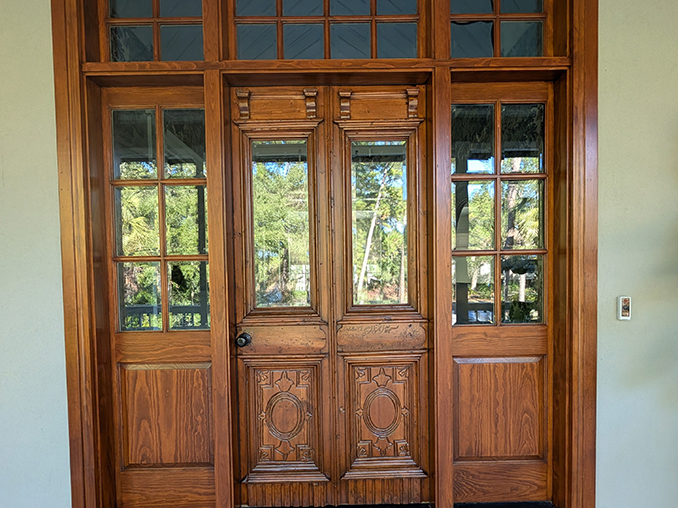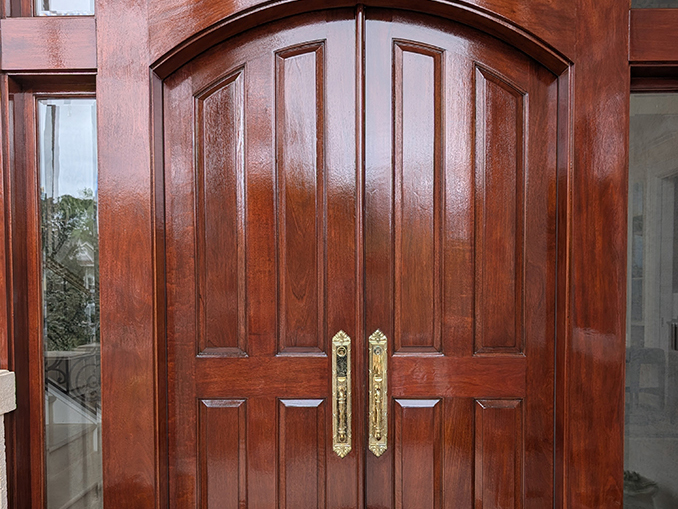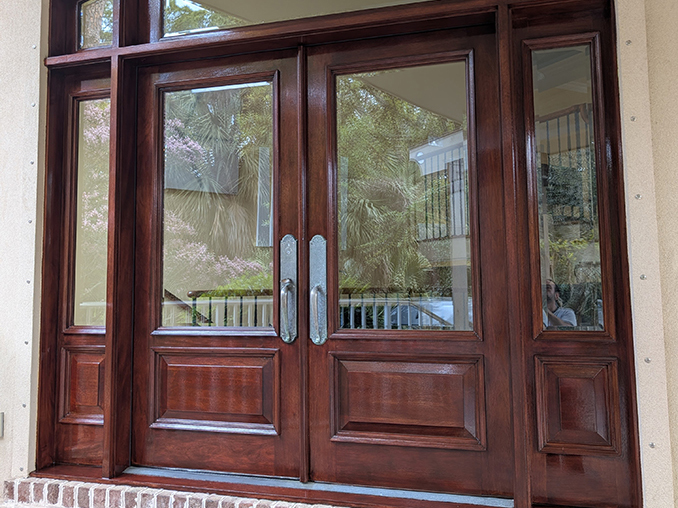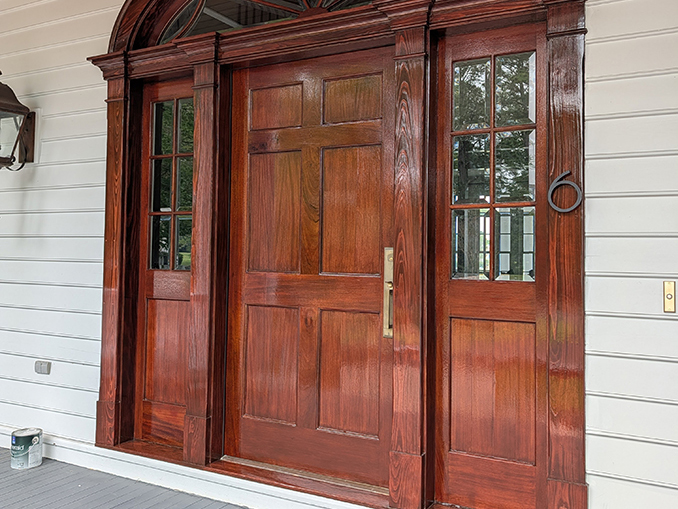


Honduran mahogany can produce one of the richest and most impressive wood entryways imaginable.
It can also be one of the most challenging woods to make visually consistent.
A grand entryway is rarely constructed from one continuous piece of wood. Doors, panels, jambs, sidelights, transoms, moldings, and other architectural components may contain numerous individual boards. Each piece can begin with its own natural color, grain, figure, density, and undertone.
As mahogany ages, those differences may become even more apparent.
One board can develop a deep reddish-brown tone while another remains lighter, warmer, cooler, or more golden. Sun exposure, previous finishes, grain orientation, age, and the natural characteristics of each piece can all influence the final appearance.
The result can look less like one cohesive mahogany entryway and more like a collection of unrelated boards.
Correcting that variation is one of Front Door Refinishing's specialties.
Fourth-generation master refinisher Lance Daniel Aulffo uses decades of hands-on refinishing experience, custom stain development, toning, glazing, shading, and wood-specific color theory to bring individual mahogany components into greater visual harmony while preserving the grain and depth that make genuine mahogany so desirable.
If your mahogany entryway looks uneven, patchy, or mismatched, the answer may not be darker stain. It may require board-by-board color correction.
Honduran mahogany, also widely known as genuine mahogany, is prized for its beauty, stability, workability, natural luster, and distinctive grain.
But the name “mahogany” does not mean every board looks the same.
Natural heartwood can range considerably in color. One piece may begin relatively pale or pinkish brown, while another can be substantially darker and more reddish brown.
Grain can also vary from straight to interlocked, irregular, or wavy.
Put several of those pieces together in one elaborate entry system and natural variation is inevitable.
That variation can become more complicated as the wood ages.
Individual boards may change visually at different rates depending on their natural characteristics, grain orientation, finish history, and exposure to sunlight and weather.
An entryway that once appeared relatively consistent can therefore develop increasingly noticeable contrasts over time.
Removing an old finish is often the moment when the real challenge becomes visible.
A dark, heavily pigmented, or repeatedly coated finish can hide substantial variation between the individual pieces of an entryway.
Once those coatings are removed, Lance can see the actual wood underneath.
One panel may be deep red.
The stile beside it may be pale brown.
A rail may lean orange.
The sidelights may have entirely different undertones.
The transom may react differently from all of them.
At that point, applying the same stain color across every surface will not necessarily create a uniform result.
In fact, it can make the differences even more obvious.
That is why Lance approaches highly varied Honduran mahogany more like a puzzle than a standard staining project.
Each board has to be understood in relation to every board around it.
A common assumption is that if every piece of mahogany receives the same stain, every piece will finish the same color.
Wood does not work that way.
Stain is translucent. It interacts with the natural color underneath it.
Imagine applying the same transparent red-brown color over three different backgrounds:
The stain may be identical, but the finished colors will not be.
The original wood remains part of the color equation.
That distinction separates wood color matching from ordinary opaque paint matching.
With paint, the objective is often to cover the substrate with a consistent color.
With fine wood finishing, the goal is usually to change the color while preserving visible grain, figure, depth, and character.
That requires a different way of thinking about color.
On highly varied entryways, Front Door Refinishing may formulate different colors for different boards.
Rather than asking, “What stain color should this door be?” Lance evaluates questions such as:
In some projects, two or three different color formulations may be enough.
In more complicated entry systems, individual areas may require their own adjustments.
The objective is not to force every piece into an unnaturally identical color.
It is to create enough visual continuity that the eye reads the entryway as one thoughtfully finished architectural composition.
There are situations where one naturally dark mahogany board cannot reasonably be made lighter without compromising the desired appearance or requiring an unnecessarily aggressive treatment.
When that board is visually attractive on its own, Lance may use it as the reference point.
The darkest standalone board may first receive a clear finish so its true final color and depth become visible.
That board then establishes the target.
Lance develops the color of the lighter surrounding pieces toward it using different combinations of stain, toner, glaze, and selective color adjustment.
This reverses the usual assumption that every board should simply receive the same stain.
Instead, the entryway is built visually around the component that sets the practical color limit.
It is one of the reasons mahogany color matching requires judgment rather than a predetermined formula.
Understanding color in transparent wood finishing requires more than knowing how to mix brown stain.
Every adjustment is affected by the color already present in the wood.
A board that appears too orange may not need to be made darker.
It may need a carefully controlled complementary color to neutralize some of the orange.
A piece that looks too red may require a different adjustment.
A pale board may need several translucent layers to develop the depth of an adjacent darker component without losing its grain.
The final clear coating also changes how those colors are perceived.
This means Lance is constantly accounting for:
These relationships become intuitive only after working through many different combinations over many years.
Toning is one of the most useful tools for correcting inconsistent mahogany.
A toner introduces controlled translucent color over or between stages of the finishing process.
Unlike an opaque coating, a properly developed toner can adjust color while allowing the natural wood grain to remain visible.
This is particularly helpful when a board is close to the desired color but still needs to become slightly warmer, darker, redder, browner, or more visually consistent with adjacent material.
Toning also allows adjustments to be localized.
One component may need considerably more correction than the wood directly beside it.
Treating those areas independently provides much greater control than repeatedly applying another coat of stain across the entire entryway.
Glazing provides another layer of control.
A glaze can add warmth, shadow, depth, age, or subtle shifts in color without completely obscuring what has already been created underneath.
On a mahogany entryway, glazing may help bring a lighter component toward the visual depth of an older, richer board.
It can also help soften transitions between areas that respond differently to stain.
Lance uses these techniques selectively.
The goal is not to build up so much pigment that genuine mahogany begins to resemble painted wood.
The goal is to preserve the depth and movement of the grain while making undesirable color differences less distracting.
Occasionally, color is only part of the problem.
One board may have strong, beautiful figure while the component beside it has very little visible grain.
A repaired section may have different grain characteristics from the original material.
In those circumstances, color correction alone may not completely unify the entryway.
Lance's decorative-painting background allows him to introduce subtle hand-applied grain where appropriate.
The faux grain is not intended to turn the entire entryway into faux wood.
It is used selectively to help an unusually plain or visually inconsistent area relate more naturally to the genuine mahogany around it.
When done correctly, the correction should not call attention to itself.
It should simply make the entryway feel more cohesive.
One way to hide inconsistent wood is to make everything progressively darker and more opaque.
That may conceal differences.
It can also conceal much of the reason mahogany was selected in the first place.
Heavy layers of pigmented stain can reduce grain clarity, flatten figure, build unevenly in profiles, and eventually leave an entryway looking coated rather than refinished.
Front Door Refinishing takes a different approach.
When natural variation needs correction, Lance works through the individual colors and components rather than automatically burying them beneath a dark uniform layer.
That process requires more time.
It also retains far more control over the finished appearance.
Mahogany is valued not simply because it is brown or red.
It has depth.
Certain pieces appear to change as light moves across the grain. Figured sections can display visual movement and a sense of dimension beneath a clear finish.
A successful color-correction process should preserve those qualities.
That is why the ultimate goal is not perfect uniformity.
Natural wood should still look natural.
Small variations contribute to its character.
The distinction is between attractive natural variation and distracting inconsistency that breaks up the visual continuity of an entryway.
Lance's role is to determine where that line falls and make corrections without stripping the wood of its natural personality.
The larger the entryway, the more complicated color matching can become.
A grand entrance may include:
Each component can respond differently.
The main doors may have spent years in direct sun while the transom remains protected beneath a deep overhang.
Interior-facing wood may retain a substantially different color from the weathered exterior.
Sidelights may even have been manufactured from a different batch of lumber.
A cohesive result requires seeing all of these components as one system.
On weathered doors, the protected interior face can sometimes provide an important reference for what the entryway once looked like.
The exterior may have faded, darkened unevenly, or developed discoloration from years of sun and weather exposure while the interior retains a richer, more stable appearance.
When appropriate, the interior can help establish a color direction for the exterior refinishing.
That does not mean an exact match is always possible or desirable.
Exterior and interior surfaces experience different lighting and environmental conditions.
But a protected area can provide valuable clues about the original character of the wood and the owner's preferred appearance.
Color correction works best as part of a disciplined overall refinishing process.
Lance's proprietary 18-phase, non-abrasive, multi-step process is designed around the condition and construction of each individual entryway.
Depending on the door, stages may include:
Color development continues throughout the project because each additional finishing stage can influence the appearance of the wood.
Clear finish is not visually irrelevant.
Once the first clear coat is applied, mahogany often gains substantially more richness, depth, and saturation.
Colors that appeared relatively muted during the staining stages can suddenly become warmer or deeper.
This is another reason Lance does not evaluate mahogany color solely while the wood is raw.
The final decision has to anticipate what the entryway will look like after the complete finishing system is built.
On challenging projects, this can involve repeated samples and adjustments before moving forward.
The selected sheen also changes how mahogany is perceived.
Gloss can produce exceptional visual depth and make attractive figure particularly dramatic.
Semi-gloss maintains substantial richness with more restrained reflection.
Satin creates a softer appearance and can reduce the emphasis on natural surface texture.
Color and sheen should therefore be considered together.
The same mahogany stain can appear different under gloss than it does under satin because reflected light changes how the eye reads color, depth, and grain.
Front Door Refinishing evaluates the final sheen in relation to the wood, architecture, exposure, and client's preferences.
Mahogany is frequently found in high-end entry systems throughout Hilton Head Island, Bluffton, and surrounding Lowcountry communities.
The coastal environment presents additional challenges.
Strong sunlight, heat, humidity, rain, and differing levels of exposure can create substantial visual differences across one entrance.
A lower panel may experience intense sun while an upper area remains shaded.
One door in a double-door system may receive more afternoon sun than the other.
These differences can influence both finish deterioration and the appearance of the wood beneath it.
Front Door Refinishing's experience refinishing mahogany entryways throughout the Lowcountry provides important context when evaluating how those surfaces have changed and how they should be refinished.
Color-unification techniques become especially valuable on large architectural projects.
Front Door Refinishing's experience includes multi-door mahogany estate projects, grand residential entrances, clubhouse doors, historic and institutional properties, and other significant architectural woodwork.
On a property with numerous mahogany doors, consistency becomes both a technical and design concern.
Every door does not need to be artificially identical, but the woodwork should relate visually across the architecture.
Large projects require careful control of color direction, stain formulation, sheen, sequencing, and final appearance.
No formula can account for every variation found in genuine mahogany.
A stain chart cannot tell a refinisher exactly how one particular board will interact with the color already in the wood.
A photograph cannot reveal every undertone.
And the same mixture that corrects one board may make the next board worse.
This is where experience becomes difficult to separate from technique.
Knowing when to add color is important.
Knowing when to stop is equally important.
Unifying Honduran mahogany is some of the most challenging and rewarding color work I do.
When I strip an entryway, I never know exactly what the individual boards are going to reveal. Sometimes they are relatively close. Other times it looks like somebody assembled the entrance from completely different colors of wood.
That is when the puzzle begins.
I do not automatically put the same stain on every board and hope they come together. I study each piece and decide what it needs in relation to everything around it.
On some entryways I may mix three or more different colors.
There are also times when the darkest individual board becomes my benchmark. If it has an attractive natural color and cannot reasonably be lightened, I may clear coat that board first and then work board by board to bring the rest of the entryway toward it.
This kind of color work was not something I learned from a formula.
It came from decades of trial, error, refinishing, decorative painting, mixing colors, making samples, and learning how transparent colors interact with real wood.
The goal is never to make beautiful mahogany look painted.
The goal is to make the eye see one complete entryway instead of a collection of unrelated boards.
— Lance Daniel Aulffo
Fourth-Generation Master Refinisher
Natural mahogany can vary significantly from one board to another. Differences in heartwood color, grain, figure, age, exposure, and previous finishing can all affect the final appearance. An elaborate entryway constructed from many individual components may therefore reveal considerable variation once its old finish is removed.
Genuine Honduran mahogany commonly darkens as it ages. However, individual pieces within an entryway may not change in exactly the same way or appear identical because the original wood, grain, exposure, and finish history can differ.
They can often be brought into much greater visual harmony, but the objective is generally not to make natural wood artificially identical. Custom stains, toning, glazing, shading, and selective decorative grain work can reduce distracting differences while retaining visible natural grain.
Because stain is translucent. The natural color beneath it remains part of the finished appearance. Applying one stain over boards with very different starting colors can produce very different finished colors.
That depends on why the board is dark and how deep the coloration extends. Sometimes previous finish or surface discoloration can be removed or reduced. Naturally dark heartwood cannot always be made substantially lighter without compromising the material or desired appearance. In those situations, it may make more sense to use the dark board as a reference and adjust lighter components toward it.
Toning introduces controlled translucent color during the finishing process. It allows the color of a board to be adjusted without completely hiding the natural grain beneath it.
Glazing uses transparent or semi-transparent color to add depth, warmth, shadow, or fine color correction. It can be particularly useful after initial staining when individual mahogany components still require adjustment.
No. On a genuine mahogany entryway, the objective is to preserve and refine the real wood. Faux-grain techniques may occasionally be used selectively when a plain or repaired component needs more visual grain, but they are only one tool within a broader color-correction process.
Often, yes. Front Door Refinishing uses custom stain formulations, toners, glazes, and board-specific color correction rather than relying solely on increasingly opaque layers to conceal variation. The available options depend on the condition of the wood and previous finish.
The term genuine mahogany is commonly used for mahogany within the Swietenia genus and is often associated with Honduran or big-leaf mahogany, Swietenia macrophylla. It is distinct from a number of unrelated woods that have historically been marketed using “mahogany” in their common names.
Wood identification from photographs alone can be uncertain. Grain, color, construction, age, and other characteristics can provide clues, but definitive identification may sometimes require closer examination. Front Door Refinishing does not need to force a species identification before evaluating what the existing wood requires.
Yes. Front Door Refinishing is based in the Hilton Head Island and Bluffton area and specializes in furniture-grade grand entryway refinishing. Mahogany is common in high-end Lowcountry entry systems, and Lance has extensive experience correcting color variation in mahogany doors and architectural woodwork.
Yes. Front Door Refinishing's portfolio includes substantial mahogany projects involving numerous exterior doors as well as grand residential, clubhouse, institutional, and specialty entryways.
In many situations, newer or lighter material can be adjusted to relate more closely to surrounding aged mahogany through custom staining, toning, glazing, and color correction. Exact results depend on the wood itself, existing finish, grain, and desired appearance.
The process considers the natural color of the existing boards, the darkest practical reference points, surrounding architecture, interior or protected wood when relevant, the client's preferences, and how the color changes beneath the final clear finish.
Genuine Honduran mahogany is desirable precisely because it has natural depth, variation, and character.
Those same qualities make it demanding to refinish well.
When an entryway contains boards ranging from pale brown to deep red, applying one stain to everything may not solve the problem.
Sometimes the work requires three colors.
Sometimes it requires toner.
Sometimes glaze.
Sometimes subtle grain correction.
And sometimes the entire color plan begins with one dark board that determines where every other piece needs to go.
That is the difference between simply staining mahogany and color matching a mahogany entryway.
Front Door Refinishing combines four generations of refinishing tradition with Lance Daniel Aulffo's decades of hands-on experience in wood color correction, decorative finishing, toning, glazing, and furniture-grade entryway refinishing.
If your mahogany entryway looks patchy, uneven, faded, or mismatched, contact Front Door Refinishing to discuss what careful color correction can accomplish.
Request a Mahogany Refinishing Consultation View Toning & Glazing Projects